
Trending
This story is from December 9, 2018
Sanjivani sugar factory’s long wait for a sweet deal
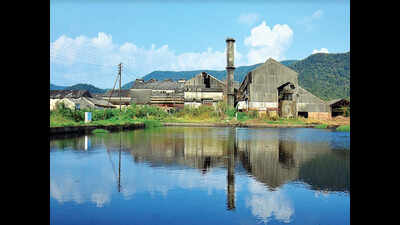
The sugar factory, which sits on 393 acres at the foothills of the Western Ghats, has an efficient water recycling system in place

393 ACRES OF SWEETNESS
The factory, which sprawls at the foothills of the evergreen Western Ghats on several hundred acres of golden farmlands at Dharbandora in Ponda taluka, can succinctly be described as ‘living history’. The premises bear an old-world charm with the office blocks very reminiscent of old British cantonments, a feeling that is only enhanced when one steps onto the cavernous mill house of simply ginormous proportions.
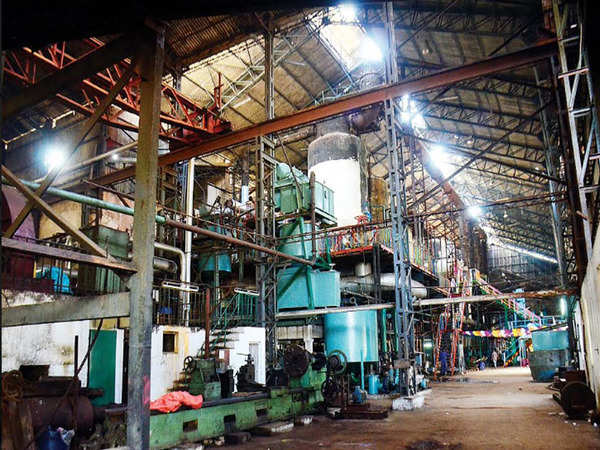
“Everything you see here, dates back to 1974, the year the factory was established,” says assistant engineer Shahadev Gawas, who explains the working of the plant in painstaking detail.
And it’s true, his words, for there is an ancient feel in the dirt-encrusted floor, the huge lumbering machinery, rusty wrought iron steps and rickety wooden mezzanine. To take in the entire structure at once, one has to crane one’s neck as far back as possible, only to be rewarded with the sight of a corrugated roof that has a few missing sheets through which slats of sunlight pour in to complete the other-wordly setting.
CAUGHT IN A TIME WARP
But when Gawas gets talking about the machinery — also dating back to its year of origin — it is clear that there is technology at work here notwithstanding its datedness. Everything is automated, from the cane unloading bay where the sugar-making process initiates to the centrifugals where raw sugar crystals are finally separated from molasses.
The process seems extremely efficient too, for from what Gawas explains, every last bit of the sugarcane is used, byproducts and all. The bagasse is used as fuel to fire up the steam turbine (yes, the factory generates its own electricity) and the molasses is sold to Goa Dairy and other factories from outside the state, who use it to produce ethanol. Even the juice mud that is separated after filtration is not wasted and is converted into compost and sold to sugarcane farmers.
Apparently for all purposes functional in its archaic modernness, why then is the sugarcane factory failing, notching an average yearly loss of approximately Rs 3.5 crore of the last so many decades. There is no single answer, as we learn.
IGNORED SOLUTIONS, ABSENT POLITICAL WILL
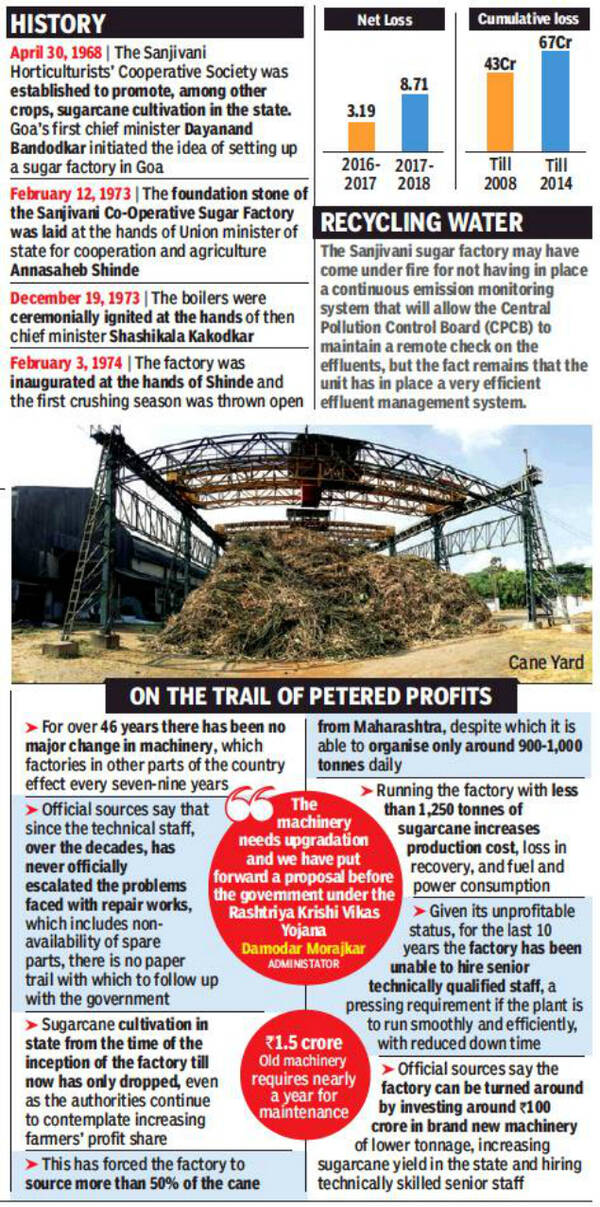
For one, the machinery is outdated. “Even its spare parts have to be custom made now,” Gawas says, adding that maintenance eats a lot of revenue, to the tune of Rs 1.5 crore every year. In fact, a 2013 report submitted by the National Sugar Institute, Kanpur, for modernization cum expansion of the factory clearly states: “Plant is very old one. More expenditure is there on the existing boiler and turbine.” The study suggested installation of a new set of boiler and turbine to reduce maintenance expenditure, which would also help in more bagasse saving. Gawas estimates that upgradation could reduce maintenance costs by as much as 50%. A penny saved is, after all, a penny earned.
“The old machinery also breaks down during production. This reduces sugar recovery from the cane as cells dry up affecting overall production and revenue,” Gawas says, sharing how they lost four days last crushing season following a major breakdown. Furthermore, workers at the factory share that refiring the boilers costs at least Rs 56,000 every time, money which is hard to come by in the present situation.
For years, various political bosses have promised to infuse the factory with funds to revive it.
In 2013, then cooperation minister Pandurang Dhavalikar had approved Rs 5 crore for Sanjivani under ‘Rashtriya Krishi Yojana’, but only Rs 1.5 cr, as last reported, reached the factory and was spent on overhauling machinery and equipment. More recently, in 2017, former chief minister Laxmikant Parsekar spoke about giving the factory a new lease of life by pumping Rs 30-35 crore for upgradations.
A lot of promises are yet to convert into reality for Sanjivani, even as those closely associated with its running put up proposal after proposal before the government to ensure its survival.
NOT SUCH A SWEET DEAL
Another problem area the Kanpur institute lists in its report is the low sugarcane production in the state: “Due to various reasons, cane cultivation is not very popular and sugarcane grown in the state does not have as much sugar content as there is in other parts of the tropical zone.
The land area available for cultivation is also less. People are mostly dependent on tourism. Being the only plant in the state of Goa, it could achieve good crushing for some decades. However, after the development of mining in the state, sugarcane area decreased drastically and they depended mostly on imported cane.”
Which brings to fore yet another reason why profit margins are in the red — more than 50% of the factory’s sugarcane requirement is met from farmers in the neighbouring state of Karnataka, which hikes costs. Import becomes necessary because the plant has a 1,250 tonnage capacity, meaning it needs as much as 1,250 tonnes of sugarcane per day to function.
Sources suggest that reducing the tonnage to about 600-900 by way of new machinery would save on expenses all around, making the factory more financially viable. But this would require at least a hundred crores, and where nothing has been done for the factory in its 46 years of existence hopes for such fund infusion seem, at best, bleak.
As of now this living giant of a machinery is gearing to hum to life for the new crushing season, ticking off one more chapter in its not-so-glorious history.
End of Article
FOLLOW US ON SOCIAL MEDIA










Hot Picks
TOP TRENDING
Trending Stories
In City
Entire Website
- 'Tirupati laddu ghee had pig & beef fat, fish oil': Row rages in Andhra Pradesh; TDP, YSRCP lock horns
- UP medical aspirants converting religion to secure MBBS seats: A look at NEET UG admission criteria around minority reservation rules
- Which Zodiac Signs Are Blessed with Divine Angelic Protection?
- After India seeks review of Indus Water Treaty, Pakistan urges 'compliance with pact'
- Hamster Kombat Daily Cipher Codes and Combo Cards for September 20, 2024: Unlock up to 1 million coins
- FATF report warns 'Left-wing groups seeking to overthrow Indian govt'
- Sumit Nagal's $50,000 demand to play for India sparks controversy
- Cognizant CMO Chand leaves firm, churn in marketing team
- Solar eclipse 2024 ‘ring of fire’ set to dazzle viewers – check visibility in India and timings
- Anil Ambani’s Reliance Infra looks to raise Rs 6,000 crore
- Ahead of PM Modi’s US trip, govt evasive on proposing Ukraine peace plan
- Centre seeks report on Tirupati laddu issue, says will take suitable action
- Explainer: Do you know what is symbiosexuality and abrosexuality?
- Bengal floods: Mamata writes to PM, threatens to sever ties with DVC
- 1st Test Live: India bowl Bangladesh out for 149 in Chennai
- How Israel allegedly used shell companies to orchestrate pager attack
- How Tupperware, trusted by moms and the Queen, went bankrupt
- Ex-Google employee looking for job in Canada: 'I've been reducing ...'
- Jasprit Bumrah becomes sixth Indian pacer to take 400 wickets
- SC’s YouTube channel hacked, streams videos promoting cryptocurrency

Popular Categories
Hot on the Web
Top Trends
AppleGurgaon Bike AccidentTirupati Laddu RowIsraeli Strikes on HezbollahIND vs BAN LiveJacoby BrissettIIT Companies WFH PolicyOdisha Bharatpur Police Station NewsRhea RipleyIsrael Hezbollah WarKerala Lottery ResultAssembly ElectionTirupati PrasadamEY Pune EmployeeSean DiddySandip GhoshLive Cricket Score
Trending Topics
Stree 2 CollectionSalim KhanAbdu RozikYudhra ReviewJayamSana Khan HusbandTirupati Laddoo ControversyGOAT CollectionVaazha OTT ReviewKozhipannai Chelladurai ReviewCheetahsKangana RanautAditi Rao HydariDalljiet KaurHoliday DestinationVikas SethiBest Selling Earbuds Under 1000Apple iPhone 16 ProVirat KohliWordle Answer
Living and entertainment
Latest News
SoftBank’s latest investment signals Masa’s brand-new India strategyHenry Danger: Here’s where you can see all seasons - 1 to 5Former Rapper Shyne barrow speaks about Diddy's arrest, says he "Killed" his lifeWhat happens if we see God in DreamsCon artist held for posing as customs inspector in SuratKaun Banega Crorepati 16: Amitabh Bachchan reminisces about shooting for Deewar and Kabhi Kabhie; says “Kabhi Kabhie josh mein hum log bohot kuch kar dete hain"Allu Aravind on Bollywood filmmakers having limited perspectives in their films: 'They are locked between Bandra and Juhu'Mafia ran govt in Samajwadi Party rule while 'babua' slept: Yogi AdityanathThe Interplay of Sun Signs and Numerology: Unlocking Your Ultimate PotentialAnil Ambani's Reliance Infrastructure to raise over Rs 6,000 croreHow Israel built a modern-day Trojan Horse: Exploding pagersPM Modi must take to task those abusing Rahul, says CongressGarena Free Fire MAX redeem codes for September 20: Win free in-game rewards dailyOnePlus 12 is available for Rs 35,314 only on Amazon; check exchange deal and bank offersHow to watch 'Fast and Furious' movies in chronological order and release datesAnna Sebastian Perayil’s death: EY Chairman Rajiv Memani says, ‘I truly regret…’'If they don't listen ...': Amit Shah's stern warning to MaoistsThe 3 Strongest Zodiac Signs: Powerhouses of the Zodiac Wheel
Copyright © 2024 Bennett, Coleman & Co. Ltd. All rights reserved. For reprint rights: Times Syndication Service